
Affiliate disclosure: links to quote comparison sites and to other products and services on this page are referral links. We may earn a commission at no additional cost to you. Travel insurance rates are filed with state regulators and are the same wherever you buy. Everything here is general information, not a recommendation for your situation, and not medical, legal or financial advice. Dollar amounts, percentages and time limits are typical industry ranges given for illustration, not the terms of any particular plan. The policy document controls.
We just got back from El Salvador on American Airlines. Things went wrong in both directions, which did not surprise me one bit. What did surprise me is how hard they worked to fix it.
It also got me thinking about who actually pays when a trip goes sideways. Sometimes it is the airline. Sometimes it is your travel policy. And sometimes it is you.
The trip out#
One of the two bathrooms was out of order before we left the gate. Then the baggage belt truck got stuck to the plane and would not decouple, so a maintenance crew had to come out.
I got up to use the one working bathroom about ten seconds before the ding. The announcement said we could leave as soon as everyone was in their seat. That meant me, the guy who had just shut the door. I got back to my seat fast. The whole plane watched.
We landed late. If our next flight had not also been delayed, we would have missed it. The crew asked people to let the tight connections off first, which was a nice touch. We reached El Salvador within a few hours of the plan.
The trip home#
The flight home left about four hours late and we missed our connection. American offered a 6 am flight, which was bad timing for us. We used their chat instead. The first rep could not help, so we asked for a supervisor. The supervisor moved us to a 10 am flight, and American paid for the hotel and meals.
The last leg was half empty and the gate agent moved us to better seats. My guess is other flights were late too, with connections of 30 minutes or less on opposite ends of the airport.
Overall it was an unusually good experience for American Airlines.
Ready to price this trip? Compare quotes from many carriers side by side. Compare travel insurance quotes
Why the airline paid this time#
Our delay was the kind the airline owns. The Department of Transportation treats a delay as controllable when the airline caused it, and the examples it gives are maintenance or crew problems, cabin cleaning, baggage loading and fueling. A belt truck stuck to the plane fits.
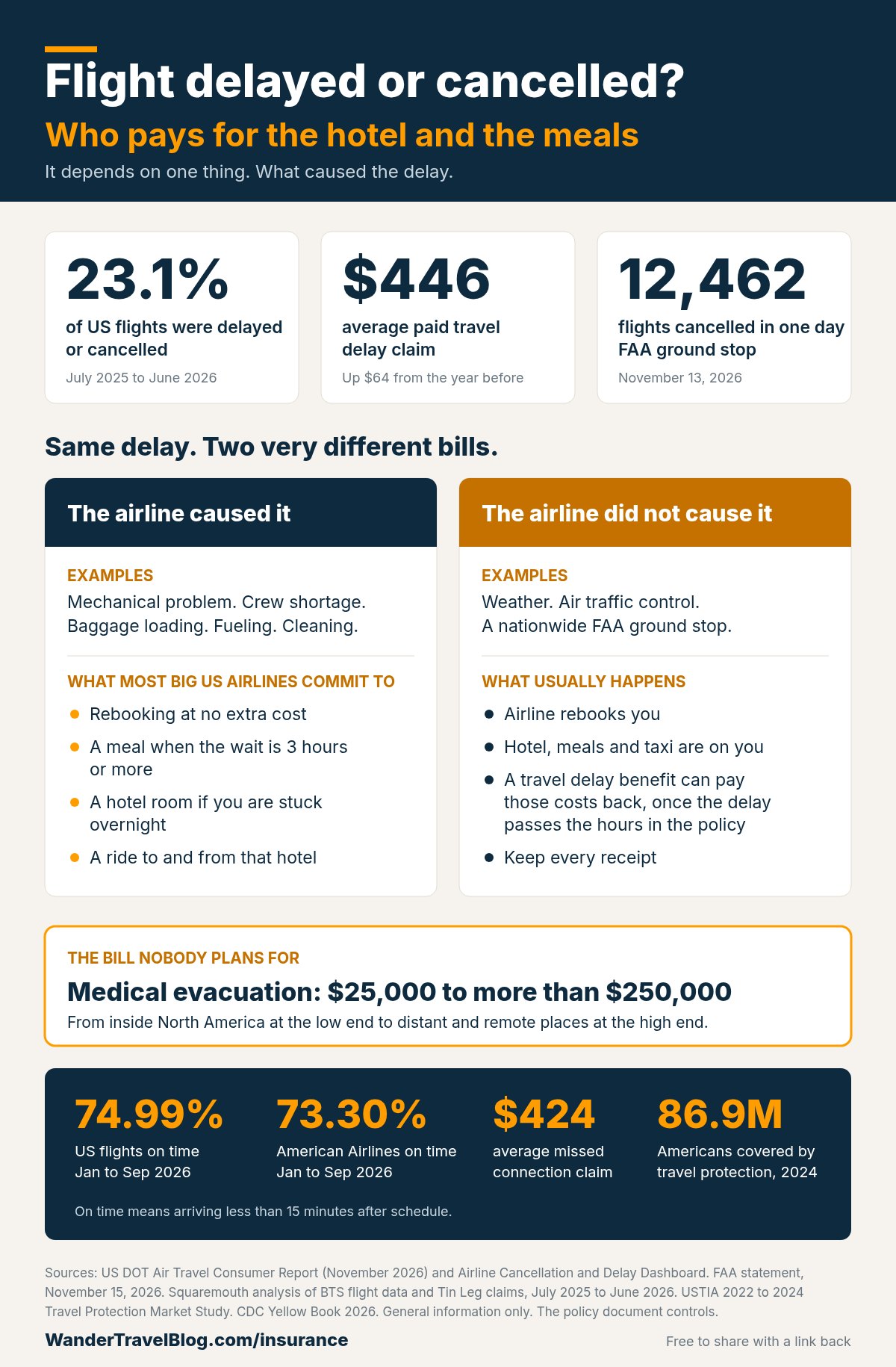
For that kind of delay American commits to rebook you at no cost, give you a meal once the wait reaches three hours, put you in a hotel if you are stuck overnight, and cover the ride to and from it. Cash for your trouble is not on the list. You can look up any carrier on the DOT Airline Cancellation and Delay Dashboard.
So this time the airline paid, and a travel policy would have had almost nothing left to pay. That is worth saying out loud, because a lot of people think insurance pays on top of what the airline gives you. It does not.
When the airline does not pay#
Weather and air traffic control are not on that list of airline causes. We got lucky here. On November 13, right in the middle of our trip, the FAA stopped departures nationwide after a network problem hit 17 of its 22 en route control centers. Operators cancelled about 12,462 flights that day, 9,082 of them at major airlines. The FAA statement has the details.
If that had been our travel day we would still have been rebooked. The hotel, the dinner and the taxi would have been ours.
That gap is what a travel delay benefit is for. Once a delay passes the hours stated in the policy, commonly three to six, and the cause is a covered one, it can pay back reasonable meals and lodging up to a daily limit. It pays what you were out of pocket. If the airline already paid, there is nothing to claim. More on the fine print in baggage and delays and missed connections.
The one claim we ever made#
Our first trip to Mexico is still a fun memory. It was the first time we travelled out of the country for a vacation. The flight home was cancelled because of storms at the other end, Atlanta if I remember right. Storms are not the airline fault, so the airline was not on the hook for a room.
We had always been told never to trust the taxi people. So when our driver suggested a condo we could rent for one night, it sounded suspicious. He gave us the number, we looked the place up online, and it checked out. We stayed the night, ate, and took a taxi back to the airport the next day.
Our travel insurance paid for the room, the food and the taxi both ways. That was the first and last claim we have ever made.
The coverage I would not travel without#
A night in a condo is an annoyance. The real reason I carry a policy is evacuation, both medical and non medical.
Medical evacuation. If you get badly sick or hurt far from a hospital you would trust, somebody has to move you. The CDC Yellow Book puts a medevac at about $25,000 inside North America and more than $250,000 from distant and remote places. Standard wording moves you to the nearest adequate facility. Getting you home to your own doctors is a better grade of plan, so read that line. Our medical evacuation guide covers how much to carry.
Non medical evacuation. This is the one for floods, volcanoes and unrest, and 2026 has made the case for it:
- In August, flooding on the Nepal and Tibet border left hundreds of travelers missing. Chinese state media reported 555 tourists evacuated from the Tibet side. (summary)
- In September, ash from Anak Krakatau shut eight Indonesian airports and stranded around 170,000 passengers. (report)
- On November 19 a Pacific storm put fire scarred Los Angeles neighborhoods under evacuation warnings. The county fire department told people, "Prepare for possible evacuations." The warnings were lifted that afternoon. (Claims Journal)
Not every plan includes non medical evacuation. Where it is included, it can pay to move you to the nearest safe place, and often home from there, when a covered disaster makes staying put unsafe. Check that it is on the policy and check the dollar limit.
If I could keep only one benefit on a policy, it would be evacuation. Everything else is money you could probably find. This one is not.
The numbers#
- 23.1 percent of US flights were delayed or cancelled from July 2025 through June 2026, according to a Squaremouth analysis of federal flight data. (ITIJ)
- $446 was the average paid travel delay claim in that study, up $64 from the year before. Missed connection claims averaged $424.
- 74.99 percent of US flights arrived on time from January through September 2026, down from 76.36 percent a year earlier, per the DOT Air Travel Consumer Report issued in November 2026.
- 73.30 percent was the American Airlines number for the same nine months.
- 12,462 flights were cancelled on November 13, 2026, the day of the FAA ground stop.
- $25,000 to more than $250,000 is the CDC range for a medical evacuation.
- 86.9 million Americans were covered by 54.8 million travel protection plans in 2024, according to the US Travel Insurance Association market study.
Who pays, in one picture#
What I would do next time#
- Ask the agent what caused the delay and write it down.
- Use the airline chat while you stand in line. If the first rep can not help, ask for a supervisor. It worked for us.
- Keep every receipt.
- Buy the policy before trouble has a name. A storm or strike that is already in the news is usually excluded. See when to buy.
- Read the delay hours, the daily limit and the evacuation limit before you buy.
Compare travel insurance quotes side by side and read those three lines on each plan.
Common questions
Does travel insurance pay if the airline already gave me a hotel?
No. A travel delay benefit reimburses costs you paid yourself. If the airline covered the room and meals, there is nothing left to claim for those. Save the claim for what the airline did not cover.
Does an FAA ground stop count as a covered delay?
It depends on the list of covered causes in the policy. Many plans cover delays of a common carrier for reasons like weather or mechanical breakdown, and some word it more broadly. Read that list before you buy. The policy document controls.
Is evacuation coverage included in every travel insurance policy?
Medical evacuation is standard on most comprehensive plans, but the limit varies a lot. Non medical evacuation for natural disasters or unrest is not on every plan. Check that both are listed and check the dollar limit on each.
Compare real quotes side by side
Plans from many travel insurers, filtered by the coverage that matters for your trip. Prices are filed with state regulators, so comparing does not cost you anything extra.
Compare travel insurance quotes